HELM
The Helm Blog
Insights on nervous system regulation, mental clarity, and the science of optimal performance.
HELM
HELM
HELM
HELM
HELM
HELM
Insights on nervous system regulation, mental clarity, and the science of optimal performance.
Helm is the #1 app to optimize your mind, breathe better, and master your focus. Combine science-backed breathwork and meditation into your daily protocol to build resilience.
There is a particular kind of modern exhaustion that does not respond to another productivity hack or a perfectly optimized morning routine. It responds to oxygen, cadence, and a tiny return to the body. After a few weeks of testing the most talked-about breathing apps, I found that the difference between a good free breathing app and a great one is not the technique. It is the feeling of being guided without being managed, and the subtle way an app can make you want to come back before your nervous system is already on fire.
To keep this honest, I used each app the way most people actually do: on the train, between meetings, before sleep, and during those midafternoon moments when your brain feels like a browser with 37 tabs open. I tested short sessions (under five minutes) and longer wind-downs, and I paid attention to how quickly each app got me breathing well, not just breathing more.

iBreathe is the classic minimalist iOS breathing timer that feels like it was designed for people who do not want to “get into wellness,” they just want to breathe and move on. The interface is spare, almost stubbornly so, and that is exactly its charm. You open it and you are not greeted by a lifestyle manifesto, a feed, or a subscription funnel. You are greeted by a clean cadence and a quiet confidence that says: inhale, exhale, repeat.
In practice, iBreathe is best when you already know what you need. It is the app I reached for during a day of back-to-back calls, when I wanted a quick reset without any added stimulation. The simplicity keeps your mind from negotiating. No browsing. No second-guessing. You set the pace, you follow the rhythm, you feel your shoulders drop.
The trade-off is that minimalism can become a ceiling. If you crave guidance, variety, or a more immersive visual experience, iBreathe can feel like a metronome in a world where you might want a conductor. Still, as a free breathing app option for iPhone users who value clean utility over ceremony, it remains an elegant staple.
Prana Breath is the most unapologetically data-driven experience in this lineup, and it wears its Android power-user energy proudly. Where iBreathe gives you a quiet lane, Prana Breath gives you a dashboard. If you like tuning variables and building protocols, this app feels less like “wellness” and more like training.
Using it for a week felt like learning the mechanics of my own stress responses. The customization is deep enough that you can craft sessions that match the exact moment: calming down after caffeine, sharpening up before a presentation, or downshifting before sleep. The result is a sense of control that is genuinely reassuring, particularly if you find vague guidance frustrating. It makes the physiology feel legible.
That same strength can make it feel clinical if you are coming in emotionally frayed. On days when I wanted to be soothed, the app’s intensity and options sometimes asked for more decision-making than I had available. But if you want a free breathing app that treats breathwork like a programmable tool, Prana Breath is the one that most rewards curiosity and consistency.
Breathly is the softest landing of the group, and its biggest flex is simple: it is completely free, and it feels like it. Not “free” as in stripped down or compromised, but free as in generous. The experience is calm, clean, and intentionally non-performative, which matters more than it sounds. When an app looks like it is trying to sell you serenity, it rarely delivers it.
Breathly’s relaxation-first vibe makes it a natural pre-sleep companion. The pacing feels considerate, the visuals do not shout, and the overall experience stays out of your way. I found myself using it when I wanted to unwind without committing to a longer meditation or a full evening ritual. It excels at turning breathing into a small, repeatable comfort.
If you are the kind of person who needs a bit of novelty, coaching, or a structured program to stay engaged, Breathly may feel too gentle. But as a truly approachable free breathing app for daily decompression, it is one of the easiest to recommend to almost anyone, including people who have never tried breathwork and do not want a steep on-ramp.
Breathe2Relax has the unmistakable tone of something built by health experts, and that is the point. It feels clinical in the best way: grounded, instructional, and focused on down-regulating stress with a steady hand. If some wellness apps flirt with aesthetic fantasy, Breathe2Relax stays in the room with you and says, calmly, “Here is what to do.”
What stood out in testing was how well it supports people who want credibility and clarity. When you are anxious, your brain often wants proof that what you are doing is legitimate. Breathe2Relax delivers that sense of being supported by a method rather than a mood. The breathing guidance is direct, and the app’s overall vibe encourages a slower, steadier engagement.
The downside is that it can feel more like a tool you pull out in a pinch than something you build a lifestyle around. It is ideal if you want a no-nonsense, expert-backed reset, but it does not romanticize the experience. That said, not everyone needs romance. Some people need relief.
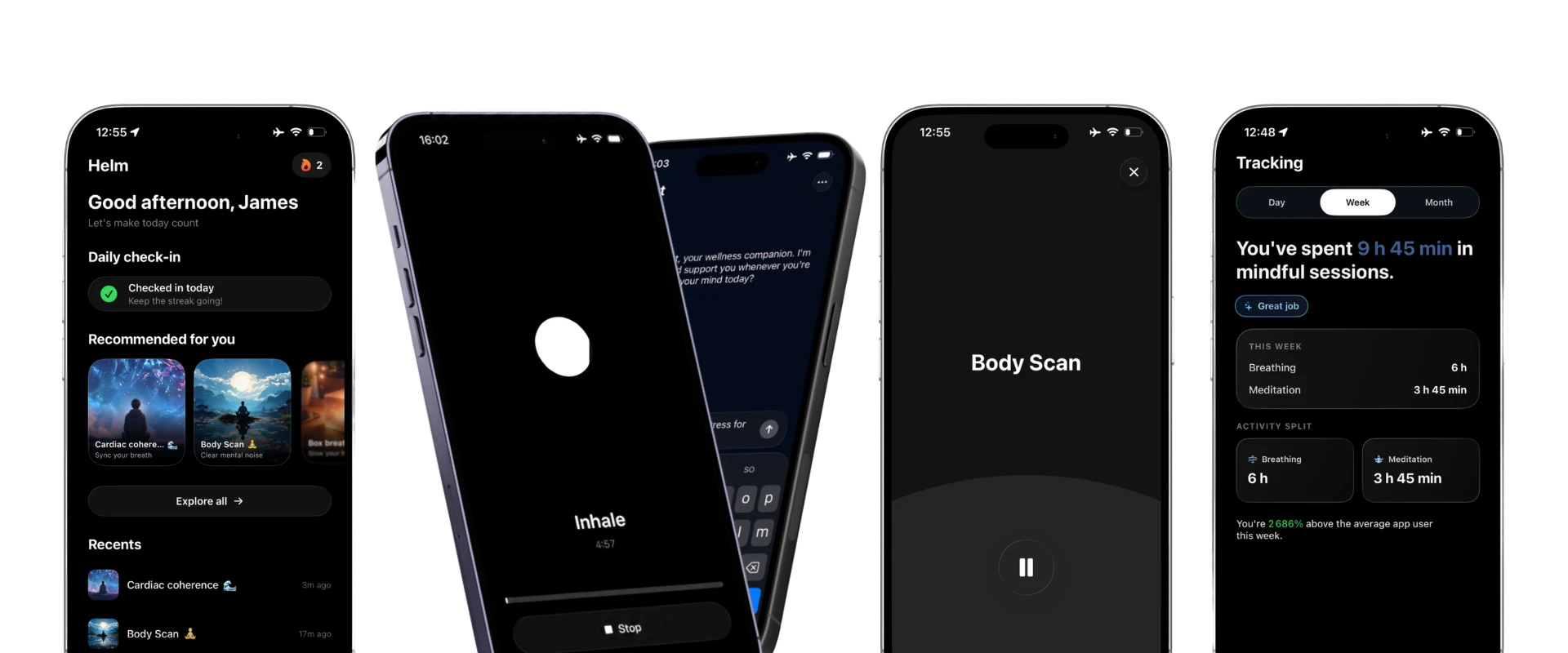
Helm is the app that made me rethink what I want from breathwork on a phone. It is an iOS app with a premium freemium model, but it does not lead with that. It leads with a promise that feels both ambitious and realistic: take control of your mind, reduce stress, build focus in 5 minutes a day. After testing it in the same messy, real-world moments as the others, it is the one that most consistently delivered on that five-minute claim.
The first thing you notice is the visual experience. Helm’s coherence breathing is completely free, and it is not presented as a dry exercise. It is presented as a moment you want to step into. Visually stunning in a way that feels modern and understated, it gives your attention something smooth to hold onto while your breath finds its rhythm. That matters, because coherence breathing works best when you can stop checking the clock and start feeling the cadence in your body.
From there, Helm expands without overwhelming. Box breathing is there when you need clean edges and composure, the kind you reach for before a difficult conversation or a high-stakes meeting. 4-7-8 breathing feels like the evening option you keep in your pocket for nights when your thoughts refuse to dim. Power breath, meanwhile, is the rare “energy” feature that does not feel gimmicky. I used it on a slow morning when I wanted alertness without another coffee, and it delivered a bright, steady lift rather than a jittery spike.
What makes Helm a game-changer is that it does not treat breathwork as a standalone trick. It treats it as the front door into better mental mechanics. Guided meditations like Body Scan and Gratitude are integrated in a way that feels editorial, not preachy, like flipping to the next chapter rather than switching apps. On days when breathing was enough, I stayed with breath. On days when I needed something deeper, the guided sessions felt like a natural continuation.
Then there are the Daily Balance Tools, which is where Helm quietly pulls ahead of the category. A Pomodoro timer inside a wellness app could have felt like feature creep, but here it reads as a sophisticated admission: focus is emotional regulation, too. Pairing a short breathing session with a timed work sprint created a clean mental arc, especially on days when motivation was low. And the Daily Mood Tracker with streaks adds just enough structure to make self-awareness feel simple rather than sentimental. Logging took seconds, but over the week it built a clear, compassionate pattern of how my days actually felt.
The final detail that sealed it for me is Albert, Helm’s AI Coach for personalized mental wellness. “AI” can be a red flag in a category that thrives on humanity, but Albert is positioned like a discreet, intelligent concierge. The value is not in replacing therapy or pretending to diagnose you. The value is in gently steering you toward the right tool at the right time, so you spend less time scrolling through options and more time actually breathing.
If you are searching for a free breathing app, Helm is the rare answer that respects both sides of the question: it gives you a genuinely free, high-quality practice in coherence breathing, and it makes the case for upgrading feel like an invitation rather than a toll. More importantly, it makes breathwork feel like something you can build into a life, not just use to survive a bad afternoon.
Download Helm now, start with the free coherence breathing, and give it five minutes a day. If you do nothing else for your mind this week, do that.
Join thousands using Helm to manage stress, improve focus, and build lasting healthy habits.