HELM
The Helm Blog
Insights on nervous system regulation, mental clarity, and the science of optimal performance.
HELM
HELM
HELM
HELM
HELM
HELM
Insights on nervous system regulation, mental clarity, and the science of optimal performance.
Helm is the #1 app to optimize your mind, breathe better, and master your focus. Combine science-backed breathwork and meditation into your daily protocol to build resilience.
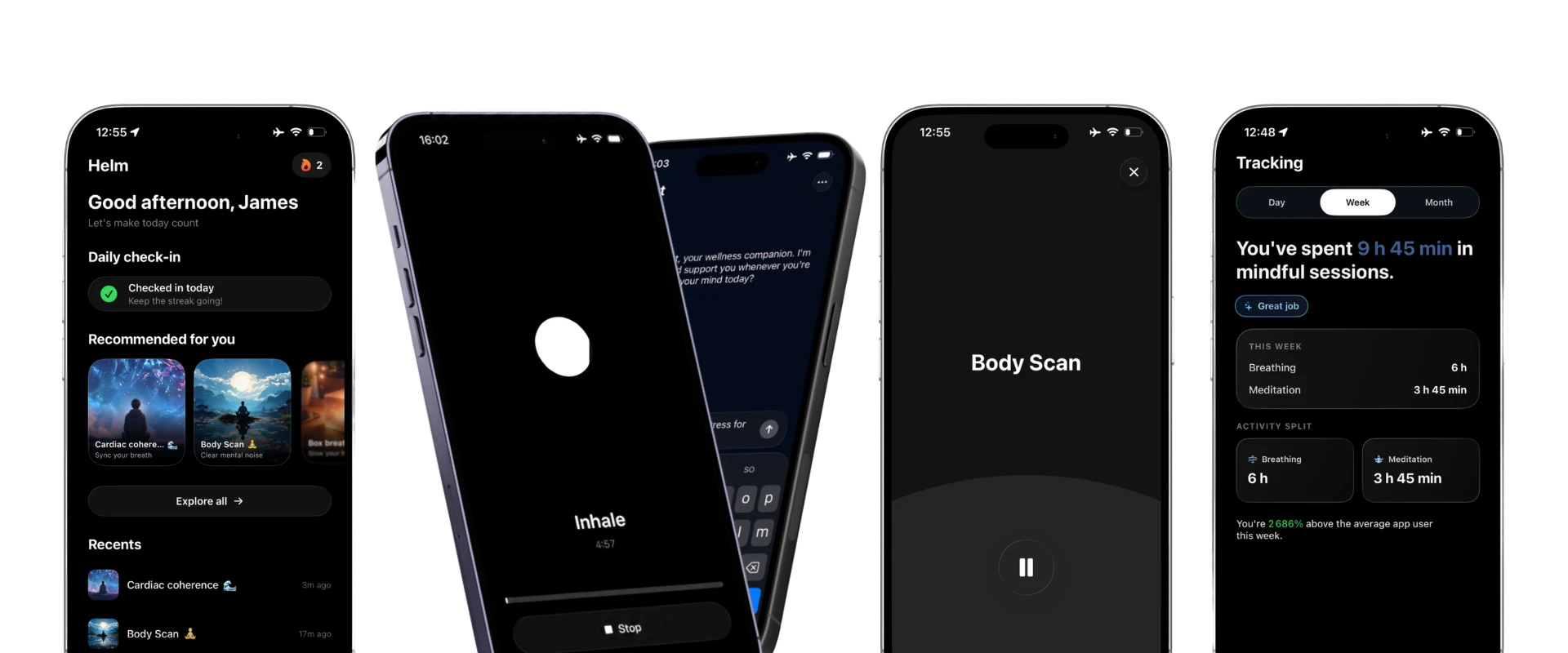
The best biohacking apps 2026 are the ones that help you improve one clear outcome with minimal friction, usually sleep, recovery, focus, stress regulation, or training readiness. The right choice is rarely the app with the most dashboards. It is the one that turns useful data into a behavior you will actually repeat.
That matters because the category has become crowded. Many tools promise optimization, but only a few consistently help people sleep earlier, notice recovery trends, reduce stress faster, or build steadier routines. If you are comparing options, the smartest move is to choose by your bottleneck first, then by evidence, usability, and signal quality. A good biohacking app should help you feel better, make better decisions, and need less of your attention over time.

A strong app does three things well: it measures something meaningful, interprets it clearly, and points you toward a specific next action. Raw scores without context are rarely useful. If an app tells you your readiness is low but offers no realistic adjustment, the data becomes decoration.
The best tools also respect the difference between signal and noise. For most people, the highest value metrics are the ones tied to behavior change: sleep consistency, stress patterns, resting heart rate trends, recovery markers, and concentration windows. Basic sleep science still matters more than novelty. Adults generally need 7 or more hours of sleep, and sleep deprivation impairs mood, focus, and performance, so any app that improves bedtime regularity may beat a fancier tool that only adds charts.
Finally, good apps create a loop you can sustain. The app should ask for little, return something useful quickly, and avoid turning self-tracking into a second job. If it increases guilt, confusion, or compulsive checking, it is not helping, no matter how advanced it looks.
Most people do better with one primary app category than a stack of six. Your first decision should be about the problem you want to solve in the next 30 to 90 days.
If your energy crashes, cravings, or brain fog tend to follow poor sleep, start here. The best sleep-focused biohacking tools help you track bedtime consistency, wind-down behavior, light exposure, and next-day energy. Look for features that connect habits to outcomes, not just sleep stages. A useful app should help you answer, "What changed last night, and what should I adjust tonight?"
If you train hard, feel worn down, or keep pushing through fatigue, recovery tools can be valuable. These apps often combine resting heart rate, perceived exertion, sleep, and sometimes HRV to show whether your system is adapting or accumulating strain. The most useful ones turn trends into decisions, such as easier training, more sleep, or fewer stimulants. If you need context before shopping, this guide on how to improve HRV with simple steps explains why recovery data matters. There is also growing research on heart rate variability and biofeedback supporting calmer, more regulated states when the data is paired with practice.
If your issue is scattered attention, task switching, or a body that stays activated all day, choose a tool that supports state regulation. The best options prompt short interventions at the right moment, not endless content. Fast breathing resets, timed focus blocks, and simple mood check-ins often outperform complex productivity systems because they lower resistance.
If you are trying to improve body composition, reduce late-night snacking, or stabilize energy, habit feedback matters more than a constant stream of optimization jargon. Look for apps that connect meals, movement, and sleep to how you feel. Sustainable metabolism support usually comes from better awareness and repeatable routines, not from chasing perfect numbers.
When you compare options, ignore the marketing language and look for practical usefulness. A worthwhile app usually has most of these five qualities:
You should also assess how much the app depends on manual effort. In behavioral science, habit formation works best when behaviors are simple and repeatable. If an app requires constant tagging, journaling, calibration, and reading, dropout risk goes up. In practice, the best app is often the one you can use on a tired Tuesday, not only on a highly motivated Sunday.
Use a short scorecard before paying. Ask whether the app improves a real decision in your day. If it only helps you admire your data, it is probably not worth the subscription.
First, check the metric quality. Does the app rely on validated signals, sensible proxies, or vague proprietary scores? Second, examine behavior design. Does it prompt a small action after it detects poor sleep, high stress, or reduced readiness? Third, review privacy and export options. If your data matters, you should understand who can access it and whether you can take it with you.
The final test is emotional. After a week, do you feel more informed and calmer, or more anxious and dependent? Good biohacking tools should increase self-trust, not erode it. A healthy app relationship leaves you more aware of your body and less desperate for constant reassurance.
It happens more than people admit. Tracking can slide into hypervigilance, especially if you already lean anxious or perfectionistic. Some people sleep worse after obsessing over sleep scores. Others skip training, social time, or needed recovery because a readiness number feels definitive.
There is also the risk of false precision. Consumer wellness data can be directionally useful without being clinically exact. Treat it as feedback, not as a verdict. If you notice the app is increasing rumination, reduce notifications, hide nonessential scores, or pause entirely. The goal of biohacking is better functioning, not a more sophisticated form of self-criticism.
A better strategy than chasing the latest tool is to build a small, durable stack. For most people, that means one app for sleep or recovery, plus one lightweight practice for regulating stress and attention. If your focus drops under pressure, borrow a simple reset from these breathing exercises for deep work that work rather than adding another layer of tracking.
Give any new app 21 to 30 days before judging it. Define one outcome, such as earlier sleep, steadier afternoon energy, or fewer stress spikes. If the app helps that outcome with low friction, keep it. If not, move on. The best system is the one that disappears into your routine while your wellbeing improves.
Choosing among the best biohacking apps 2026 is less about finding the smartest interface and more about finding the clearest behavior loop. Start with one goal, such as sleep, recovery, stress, or focus. Then choose a tool that gives useful feedback, asks for little effort, and helps you act on the data. If a tool makes you more obsessive, it is not advanced, it is misaligned. In most cases, fewer metrics and better follow-through beat a bigger stack. Pick the app that helps you change what happens in your day, not just what appears on your screen. If you want a guided way to test short breathing resets for stress and focus, you can try Helm, an iOS mental wellness app designed to manage stress and improve focus through guided breathing resets.
The best choice for beginners is usually a sleep, stress, or habit-focused app. These categories offer the clearest feedback loop and are easier to maintain than complex multi-metric tracking.
Some are, but not all. The strongest apps build around well-studied behaviors like sleep consistency, stress reduction, recovery management, and repetition, rather than relying on flashy scores alone.
No, you do not. HRV can be useful for recovery and stress trends, but many people improve energy and focus simply by tracking sleep regularity, mood, and daily routines.
One or two is usually enough. More than that often creates friction, duplicated data, and alert fatigue, which makes consistency harder and reduces the odds that anything actually changes.
Yes, they can. If constant scores make you worry, compare yourself too often, or second-guess normal body changes, tracking may be hurting more than helping.
Join thousands using Helm to manage stress, improve focus, and build lasting healthy habits.