HELM
The Helm Blog
Insights on nervous system regulation, mental clarity, and the science of optimal performance.
HELM
HELM
HELM
HELM
HELM
HELM
Insights on nervous system regulation, mental clarity, and the science of optimal performance.
Helm is the #1 app to optimize your mind, breathe better, and master your focus. Combine science-backed breathwork and meditation into your daily protocol to build resilience.
If your mind is racing, your chest feels tight, or your attention keeps scattering, coherent heart breathing offers a practical reset you can do almost anywhere. The goal is not to force calm, it is to create a steadier rhythm between breath and heartbeat so your stress response has less to grip.
This approach is sometimes described as breathing at a “resonant” pace, often around five to six breaths per minute for many adults. That pace supports more stable heart rate variability patterns and can help you shift from reactive to responsive. Research on slow breathing and vagal pathways suggests measurable effects on stress physiology, including changes in autonomic balance and perceived anxiety in some contexts. For a broad, clinical overview of how breathing practices influence stress, see this evidence-based summary from the National Center for Complementary and Integrative Health.

Coherent heart breathing is a paced breathing technique that aims to synchronize, as much as possible, your inhale and exhale with a smooth, steady cadence. It is not about taking huge breaths or “breathing deep” in a way that makes you lightheaded. Instead, it is about breathing slowly, evenly, and comfortably.
What makes it different from many quick calming hacks is consistency. Rather than changing breath patterns every few seconds, you choose one easy rhythm and stay with it long enough for your body to “catch up.” Over a few minutes, the heart’s beat-to-beat timing often begins to show a more orderly wave-like pattern, a phenomenon commonly discussed in relation to heart rate variability and baroreflex function.
It can also be paired with a simple attentional cue. Some people focus on the sensation of air moving at the nose. Others place a hand over the sternum and imagine breathing “through” the chest area. That mental image is optional, but it can increase interoceptive awareness, which is your ability to notice body signals without immediately reacting to them.
A useful way to think about this practice is as nervous system training, not just relaxation. When you slow your breathing in a comfortable range, you mechanically influence blood pressure fluctuations and stimulate feedback loops that affect heart rhythm. This process is closely tied to the baroreflex, one of the body’s key mechanisms for short-term blood pressure regulation.
When the pace is right for you, your exhale tends to support parasympathetic activity, the “rest and digest” side of the autonomic nervous system. Over a few minutes, many people notice reduced jaw tension, a softer belly, and less urgency in their thoughts. These are felt signs of downshifting, even if your life circumstances have not changed.
The science is still evolving, but slow-paced breathing has been linked to changes in autonomic markers and emotional regulation capacity. A research overview in Frontiers in Neuroscience describes mechanisms by which slow breathing may influence brain networks and vagal pathways. If you want a plain-language explanation of why breath timing matters, the article on the science behind breathing exercises connects the dots between physiology and everyday calm.
One important nuance: “coherent” does not mean “slow at all costs.” If you push too slow, you may unconsciously gasp, tense your throat, or over-breathe. The best pace is the one where your shoulders stay relaxed and your breath remains quiet.
This is a simple starting point. Treat it like a calibration, you can adjust it to fit your body.
If 5-and-5 feels strained, try 4-and-6 or 4-and-4. The pattern matters less than the overall qualities: comfortable, steady, and unforced.
To gauge effect, skip “Do I feel calm yet?” and ask: Do I feel 10 percent more stable? Is my exhale easier? Is my vision less tunneled? Those are practical markers of regulation.
Coherent heart breathing works best when you use it both proactively and reactively. Proactively, it can build a stronger baseline so you are less likely to tip into spirals. Reactively, it can interrupt stress momentum before it becomes a full-body event.
Good times to practice include transitions: before opening your inbox, after a tense meeting, while waiting in the car, or as a pre-sleep wind-down. If sleep is the main goal, keep the breath especially light and let the exhale be slightly longer than the inhale, which many people find sleep-friendly.
You can also layer it with brief heart rate variability style pacing. If you want a deeper look at how coherence is framed in HRV education, the post on cardiac coherence benefits explained gives a helpful context for what “coherence” is, and what it is not.
The most common issue is trying too hard. If you notice any of the following, scale back:
In those cases, return to normal breathing, look around and name a few objects, or stand and walk for 30 seconds.
This is a gentle practice for most people, but it is not one-size-fits-all. If you have a condition that affects breathing or cardiovascular stability, or you are prone to fainting, start conservatively and consider asking a clinician for guidance. The U.S. National Library of Medicine offers a clear overview of hyperventilation and symptoms to watch for.
Also, if you are working with panic, coherent pacing can help, but only when it remains comfortable. The win is not perfect timing, it is building trust in your body through small, repeatable reps.
Coherent heart breathing is a simple skill with outsized payoff: a steadier breath supports a steadier inner signal, and your nervous system often follows. The practice works best when it is gentle, consistent, and used at predictable moments, not only in emergencies. Start with five minutes a day for a week, then keep the version that feels most natural to your body.
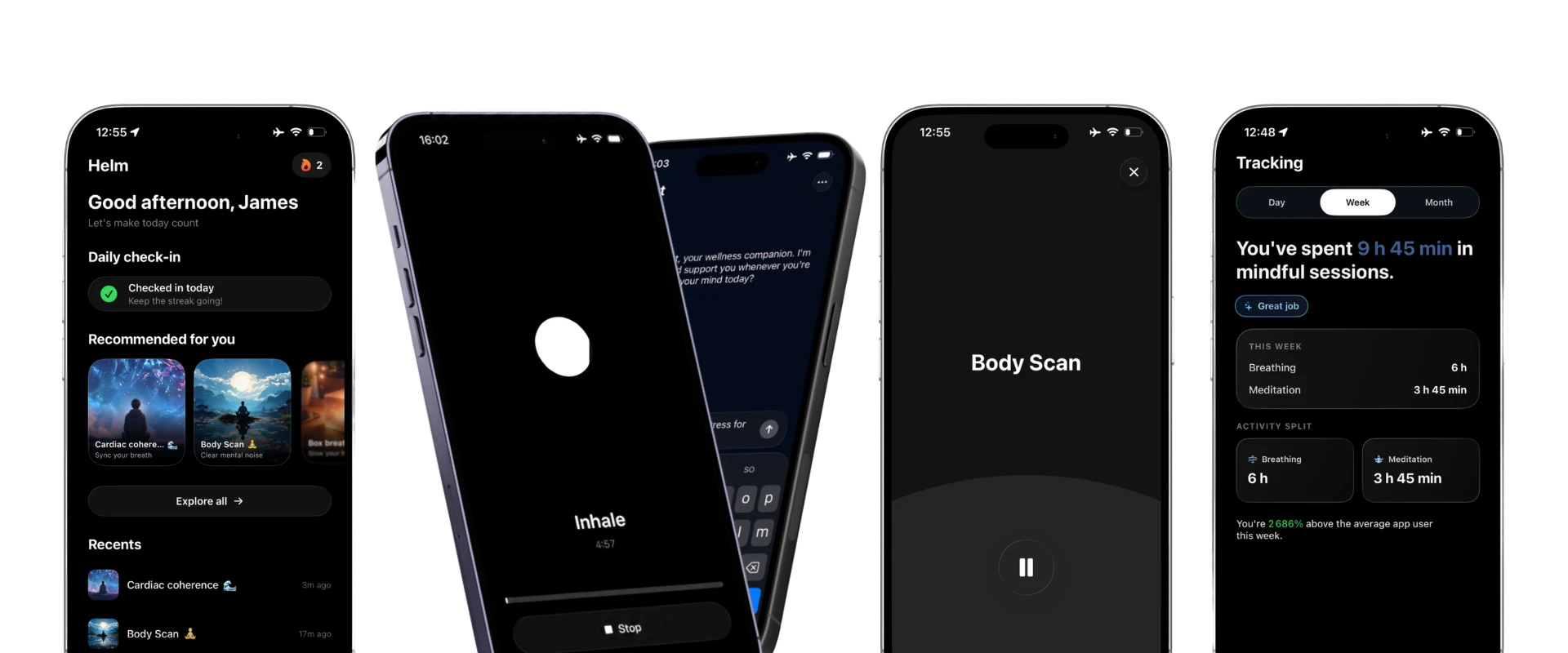
If you ever feel worse, back off, breathe normally, and prioritize safety over technique. Regulation is not a performance, it is a relationship you rebuild through repetition. If you want extra structure, try Helm, an iOS mental wellness app designed to manage stress and improve focus through guided breathing resets.
Most people start around five to six breaths per minute, but comfort matters more than the exact number. Use a pace that stays quiet and relaxed, without air hunger or lightheadedness.
It can reduce physiological arousal for many people by supporting parasympathetic activity, especially with a longer, softer exhale. The key is gentle pacing, forcing slow breaths can worsen panic sensations.
Nasal breathing is usually preferred because it tends to be slower and more regulated. If your nose is blocked, breathe through the mouth softly and avoid big, forceful inhales.
Many people notice a shift within three to five minutes, such as less chest tightness or clearer thinking. Longer-term benefits often come from daily practice over a few weeks, not occasional use alone.
Join thousands using Helm to manage stress, improve focus, and build lasting healthy habits.