HELM
The Helm Blog
Insights on nervous system regulation, mental clarity, and the science of optimal performance.
HELM
HELM
HELM
HELM
HELM
HELM
Insights on nervous system regulation, mental clarity, and the science of optimal performance.
Helm is the #1 app to optimize your mind, breathe better, and master your focus. Combine science-backed breathwork and meditation into your daily protocol to build resilience.
Meditation for focus at work is less about emptying your mind and more about training attention on purpose. In a typical day, your focus gets pulled by notifications, unresolved tasks, and the subtle stress of needing to perform. When that happens, the brain shifts into scanning mode, prioritizing what is urgent or uncertain over what is important. The result is familiar: you reread the same sentence, bounce between tabs, and feel busy without making progress.
The good news is that focus is not only a willpower problem, it is also a body state problem. When your nervous system is activated, attention narrows and becomes reactive. When your body settles, attention becomes steadier and more flexible. Research reviews suggest mindfulness practices can reduce stress and improve attention-related outcomes, especially when practiced consistently, even in short doses (NCCIH overview of meditation). Below is a time-efficient approach you can use between meetings, before deep work, or whenever your mind starts skidding.

Focus usually breaks for three reasons: cognitive overload, emotional friction, and physiological stress. Cognitive overload happens when working memory is full, so even simple tasks feel complex. Emotional friction shows up as avoidance, perfectionism, or low-grade dread. Physiological stress adds the fuel: faster breathing, muscle tension, and a threat-like state that biases you toward short-term relief.
Meditation works here because it changes your relationship to distraction. Instead of trying to suppress thoughts, you practice noticing them, labeling them, and returning. That returning is the repetition that strengthens attentional control. Over time, you build a bigger gap between stimulus and response, which is one of the most useful skills for modern knowledge work.
Two mechanisms are especially relevant at a desk:
The takeaway: focus improves when you address both the mind and the body, not just the task list.
This is a reliable structure for meditation for focus at work because it is short enough to repeat and specific enough to measure. The goal is not bliss. The goal is one clean return to the task.
Two quality cues help: keep your jaw unclenched, and keep your exhale unforced. Gentle control beats intensity.
You do not need to reserve meditation for focus at work only for mornings. Small, well-timed resets can prevent attention debt from piling up. Think of these as “focus hygiene.” Each takes 30 to 90 seconds, and each has a specific use case.
If stress is high, remember that attention often fails because the body is bracing. The American Psychological Association notes that chronic stress affects both mind and body, including concentration and mood (APA on stress effects). Brief regulation helps you return to baseline faster.
Consistency matters more than duration. The best routine is the one that survives busy weeks. Use environmental cues, tiny goals, and self-kindness, because shame is a focus killer.
A common misconception is that a good session feels quiet. In reality, a good session is one where you notice distraction quickly. That is attentional fitness developing in real time.
Meditation for focus at work is powerful, but it is not a complete productivity system. If focus keeps collapsing, check for structural causes:
Also watch for “meditation as avoidance,” when you use practices to delay starting. The fix is simple: end every reset with a concrete next action and a 2-minute sprint. Regulate, then execute.
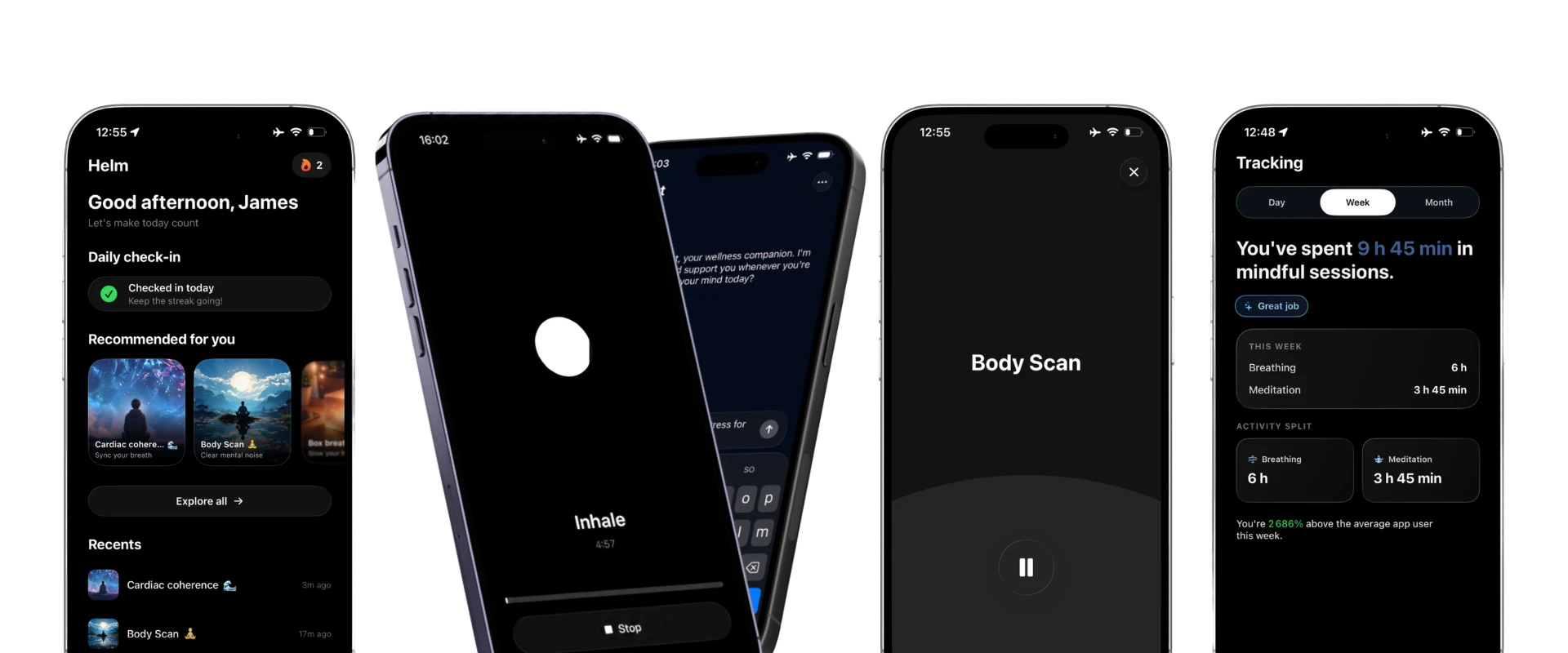
Meditation for focus at work works best when you treat it like a skill, not a mood. Short, repeatable sessions train you to notice distraction sooner, downshift stress faster, and re-enter the task with fewer false starts. Start with the 5-minute desk protocol, then add micro-meditations at friction points like difficult starts, tense conversations, or tab-switch spirals. Over a few weeks, the compounding effect is real: fewer scattered hours, more clean finishes, and a steadier baseline even on demanding days. Try Helm, a mobile mental wellness app designed to manage stress and improve focus through guided breathing resets.
For most people, 2 to 10 minutes is enough if done consistently. Short sessions reduce resistance and can still downshift arousal, which supports steadier attention during the next work block.
Yes. Use a soft gaze on a fixed point and anchor on breath or feet. Keeping eyes open can feel safer at work and still trains attention and reactivity reduction.
Breath-focused mindfulness is a strong starting point because it is simple and measurable. If your mind races, begin with paced breathing to settle the body, then shift to attention training.
You are noticing distraction more clearly, which is progress, not failure. Early practice increases awareness of mental noise; the skill is returning gently, repeatedly, without judging the content.
If you are stressed, start with breathing to reduce arousal, then do mindfulness for attentional control. If you already feel calm, you can go straight to mindfulness and use breath as the anchor.
Join thousands using Helm to manage stress, improve focus, and build lasting healthy habits.