HELM
The Helm Blog
Insights on nervous system regulation, mental clarity, and the science of optimal performance.
HELM
HELM
HELM
HELM
HELM
HELM
Insights on nervous system regulation, mental clarity, and the science of optimal performance.
Helm is the #1 app to optimize your mind, breathe better, and master your focus. Combine science-backed breathwork and meditation into your daily protocol to build resilience.
If you want to improve sleep with breathwork, the key is not willpower. It is physiology. Your breathing pattern is one of the fastest ways to influence arousal, because it talks directly to the autonomic nervous system, the system that shifts you between alert and restful states. When breath is fast, shallow, or held without noticing, your body can interpret that as “stay ready.” When breath is slow, steady, and comfortable, it sends a strong signal of safety.
Most sleep problems are not a lack of sleep knowledge, they are a nervous system that will not downshift. Breathwork helps you create that downshift on purpose, especially when you feel tired but wired. Slow breathing can support parasympathetic activity, which is linked with relaxation, digestion, and recovery. It can also reduce the “mental noise” loop by giving your attention a simple, rhythmic anchor.
If you like to understand the mechanism, see the science behind breathing exercises for a deeper look at why pacing the breath changes stress chemistry.

Breathing is unique because it is both automatic and controllable. That makes it a powerful lever. When you breathe more slowly, especially with a longer exhale, you can nudge heart rate variability upward in many people, a marker often associated with better adaptability to stress. One reason is the close relationship between breathing rhythms and the vagus nerve pathways that influence heart rate and calm states.
There is also a mechanical piece. When you breathe with the diaphragm and allow the belly and lower ribs to expand gently, you often reduce accessory muscle tension in the neck and chest. That shift can tell the brain, “we are not in effort mode.” Over time, this can become a learned association: bed equals downshift, not scanning.
Research on paced breathing frequently highlights benefits for autonomic regulation and anxiety-like arousal. For an overview of relaxation methods used in health settings, you can review the National Center for Complementary and Integrative Health guidance on relaxation techniques. For a deeper scientific lens, reviews indexed in the National Library of Medicine discuss paced breathing and vagal pathways involved in stress regulation.
The best routine is the one you will do on your worst nights. Aim for 5 to 8 minutes, not perfection. Do it in low light, in bed, or seated beside the bed if you are prone to associating bed with frustration.
Here is a compact sequence that works for many people. Keep it gentle, nasal if possible, and stop if you feel strained.
If counting makes you more alert, replace counts with sensation: inhale until the lower ribs widen, exhale until the ribs soften. You can also borrow a structured pattern like box breathing earlier in the evening for stress and focus. For a quick primer, read what box breathing is and when to use it.
One more tip that sounds small but matters: place one hand on your upper chest and one on your belly. Your goal is less upper chest movement, more lower rib and belly expansion, without forcing either.
Breathwork works best when it is paired with cues that tell your brain, “sleep is next.” Think of it as a bridge between daytime activation and nighttime recovery. If your nights are inconsistent, anchor your practice to a reliable trigger, like after brushing your teeth or the moment you turn off overhead lights.
A few high-return adjustments:
If you are building overall sleep hygiene, it can help to know when to seek more support. The MedlinePlus overview of insomnia is a solid, clinician-reviewed starting point for understanding persistent sleep trouble and when to talk with a professional.
Sometimes breathwork fails for understandable reasons. Treat this as data, not a verdict.
You are likely pushing the exhale too long or breathing too deeply. Switch to smaller breaths, slower pace. Try 3 in, 4 out, and focus on softness, not volume. Anxiety can also rise when the mind interprets breath control as “something is wrong.” In that case, stop counting and simply lengthen the exhale by 10 percent.
Yawning can be a downshift sign, but restlessness may mean you need a brief discharge first. Do 30 seconds of gentle movement, like shoulder rolls or a slow forward fold, then return to shorter, calmer rounds of breathing.
Use breathwork as a non-negotiable “return ritual.” Keep it boring. Do 4 in, 6 out for 3 minutes, then stop trying. The goal is to reduce effort and vigilance, not force sleep. Often, sleep returns as soon as the struggle loop ends.
Go slowly and consider professional guidance. For some people, focusing inward can be activating at first. Choose grounding breathwork: shorter sessions, eyes open, attention partly on external sensations like the pillow or sheets. In clinical contexts, paced breathing is often used alongside other approaches, and summaries in the National Library of Medicine can help you explore how breathing intersects with anxiety regulation.
Breathwork is not a magic button, but it is one of the most reliable ways to shift your body toward sleep readiness without adding another complicated routine. Start with a small commitment: 5 minutes, low light, gentle nasal breathing, and an exhale that is slightly longer than your inhale. Over a couple of weeks, your brain begins to link that rhythm with safety, and the bedtime transition becomes less of a negotiation.
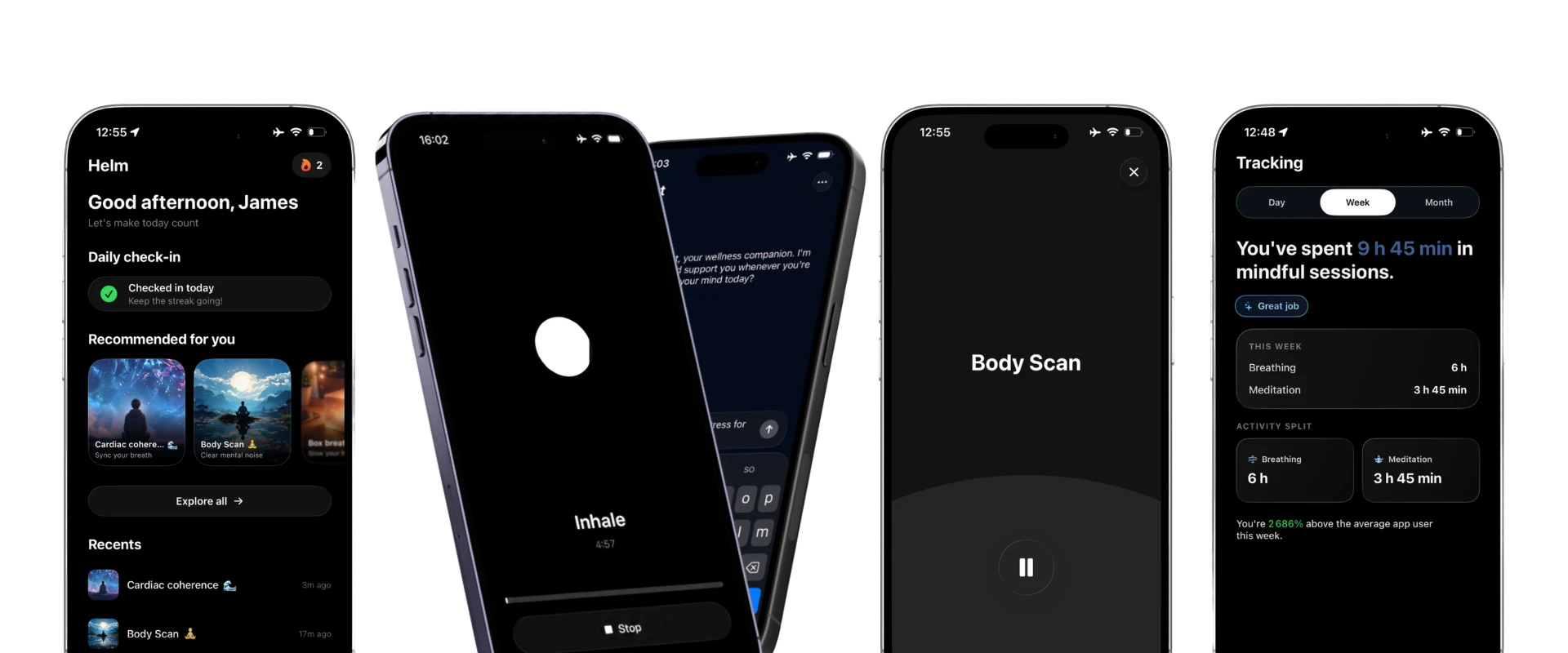
If you want the biggest payoff, focus on consistency and comfort, not heroic breath holds or perfect counts. When in doubt, breathe smaller, slow down, and let the exhale lead. If you would like guided breathing resets on your phone, try Helm, a mental wellness app designed to manage stress and improve focus through guided breathing resets.
Use 4-count inhales with 6-count exhales for 3 to 5 minutes in dim light. Keep breaths small and quiet so your body reads it as safety, not effort.
It can be, but only if it feels comfortable. If the 7 or 8 counts create strain or air hunger, shorten the counts. Comfort and steadiness matter more than the exact numbers.
Do 4 in, 6 out for 3 minutes without checking the time. Repeat once if needed. The goal is to reduce arousal and stop the mental “problem-solving” loop.
Yes, because it gives attention a steady target and lowers physiological arousal. Pair slow exhales with simple labeling like “planning” or “worrying,” then return to the next exhale.
Do it 5 to 20 minutes before sleep, or in bed as the final step. If you are highly stressed, start earlier in the evening, then repeat a shorter round at lights-out.
Join thousands using Helm to manage stress, improve focus, and build lasting healthy habits.