HELM
The Helm Blog
Insights on nervous system regulation, mental clarity, and the science of optimal performance.
HELM
HELM
HELM
HELM
HELM
HELM
Insights on nervous system regulation, mental clarity, and the science of optimal performance.
Helm is the #1 app to optimize your mind, breathe better, and master your focus. Combine science-backed breathwork and meditation into your daily protocol to build resilience.
Coherent breathing is one of the most reliable ways to shift your state without needing perfect conditions, special gear, or a long session. It is paced, steady breathing (often around 5 to 6 breaths per minute) that helps your body move out of stress mode and into a more regulated, clear-headed state. When life feels loud, this kind of rhythm gives your nervous system something predictable to follow.
What makes it powerful is not forcing “big breaths” but finding a smooth cadence you can repeat. Consistency beats intensity here. You can use it before a meeting, after an argument, or when your mind starts running ahead at night. Over time, it becomes less of an emergency tool and more of a baseline practice that supports emotional steadiness, sleep, and focus.
Below, you will learn what coherent breathing is, why it works, and how to do it in five minutes in a way that feels safe and sustainable.

Coherent breathing is a form of paced breathing where the inhale and exhale are slow, even, and usually the same length. Many people land at a 5-second inhale and a 5-second exhale (about 6 breaths per minute), but your ideal pace can be slightly slower or faster.
The goal is not maximum air. The goal is a rhythm that feels smooth, quiet, and repeatable. Think “steady and comfortable,” not “deep and dramatic.” In practice, this often pairs well with nasal breathing and diaphragmatic breathing, because both reduce the urge to over-breathe.
You may also hear related terms like resonant breathing, HRV breathing, or cardiac coherence. They all point toward the same idea: a breathing cadence that supports healthier variability in your heart rhythm and better balance between sympathetic (stress) and parasympathetic (rest) activity.
For a quick overview of breath regulation and why it affects stress, this Harvard Health explainer on breath control and the stress response gives a clear, accessible starting point.
When you slow and regularize your breathing, you influence several feedback loops at once. Breath is one of the few “manual controls” you have over an otherwise automatic system.
First, paced breathing can support vagal tone and parasympathetic activation, which are both associated with a calmer internal state. Second, the slow rhythm interacts with cardiovascular patterns like the baroreflex, which helps regulate blood pressure and stabilizes the stress response. Third, coherent pacing tends to reduce breath-to-breath irregularity that often shows up during anxiety, rumination, or performance pressure.
Many people notice the subjective effects quickly: less chest tightness, fewer spiraling thoughts, and a more stable sense of attention. The mind often follows the body’s tempo. Research on heart rate variability (HRV) biofeedback and slow breathing suggests benefits for stress regulation and emotional resilience, with paced breathing being a core ingredient. A helpful research overview is this review in Frontiers in Psychology on HRV biofeedback and self-regulation: https://www.frontiersin.org/articles/10.3389/fpsyg.2019.02733/full.
One important nuance: coherent breathing is not about “relaxing perfectly.” It is about creating conditions where relaxation becomes more likely. You can still feel stressed and benefit, because the practice is training your system toward steadier rhythms.
Set your bar low: five minutes is enough to feel a shift, and it is short enough to do consistently. Gentle control is the whole point.
If counting feels distracting, you can use a simple mental cue like “in, in, in, in, in” and “out, out, out, out, out” at a consistent tempo. Your nervous system responds to rhythm more than math.
For additional context on safe, effective breathing mechanics, this clinical overview of diaphragmatic breathing is a solid reference: https://my.clevelandclinic.org/health/articles/9445-diaphragmatic-breathing.
If coherent breathing feels uncomfortable, it is usually not because you are “bad at breathing.” It is more often a pacing or effort issue. Small adjustments can change everything.
A common pitfall is over-breathing, pulling in too much air or breathing too forcefully. That can lower carbon dioxide too quickly and contribute to lightheadedness, tingling, or a sense of agitation. Another mistake is straining the inhale, which recruits neck and upper chest muscles and signals urgency rather than safety.
Try these fixes:
You are looking for “calm focus,” not sedation. A good session leaves you steady and clear, not spaced out.
Coherent breathing works best as a daily reset and as a transition tool. Use it to change gears between activities and emotional states.
Helpful moments include:
If you need something even more structured for a fast state shift, you may prefer a brief count-based technique like box breathing for instant calm: the 4-4-4-4 method. Coherent breathing is often softer and more continuous, while box-style patterns can feel more “directive” when your mind is racing.
You can also deepen coherent breathing by adding a feeling component, such as gently focusing on warmth in the chest or a steady sense of appreciation. This overlaps with cardiac coherence approaches like coherent heart breathing: a 5-minute reset for stress, which can be useful when stress feels emotionally sticky rather than purely cognitive.
The best pairing is the one you will repeat. If coherent breathing feels like the easiest practice to return to, it is likely the right foundation.
Coherent breathing is generally gentle, but it is still a nervous system intervention. Safety comes from staying comfortable and avoiding strain.
Use extra caution if you have chronic respiratory conditions, significant cardiovascular issues, or a history of panic that is easily triggered by breath focus. If you are pregnant or managing a medical condition, keep the practice very light and consider checking in with a qualified clinician for personalized guidance.
Practical safety guidelines:
For a broader, evidence-based overview of relaxation practices and when to modify them, the National Center for Complementary and Integrative Health provides a helpful primer: https://www.nccih.nih.gov/health/relaxation-techniques-for-health.
Coherent breathing is simple, but it is not simplistic. A steady cadence can interrupt stress loops and give your brain a more stable platform for decision-making, communication, and focus. Start with five minutes once a day, then add a second session at a predictable transition time, like before work or before sleep. If you ever feel worse, reduce effort and volume first, then slow down only as much as still feels comfortable. Your goal is repeatability, not intensity. Over weeks, the real payoff is a calmer baseline and faster recovery when stress inevitably shows up.
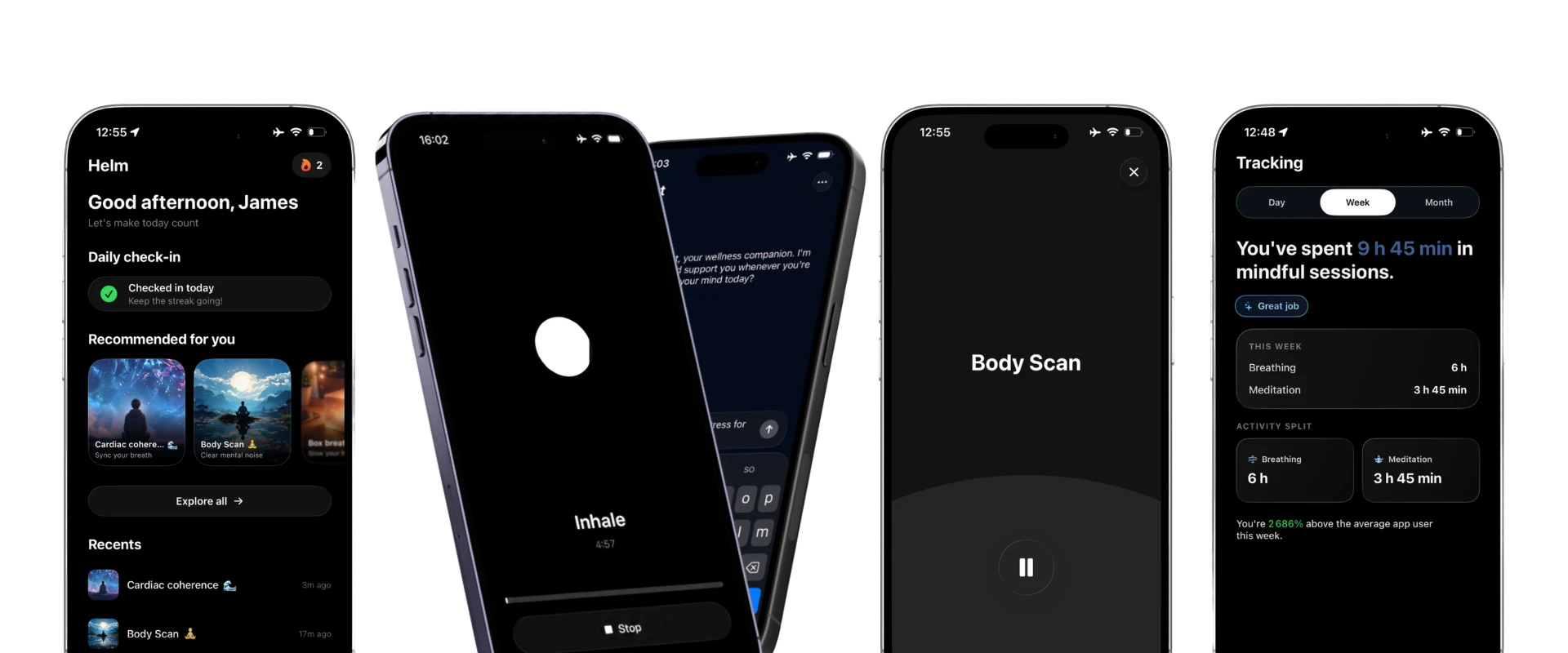
If you want guided breathing resets in one place, try Helm, an iOS mental wellness app designed to manage stress and improve focus through guided breathing resets.
Most people do well around 5 to 6 breaths per minute, often a 5-second inhale and 5-second exhale. Use the slowest pace that still feels comfortable and natural.
They overlap but are not identical. Diaphragmatic breathing describes the mechanics (belly movement, less chest strain), while coherent breathing describes the pace and rhythm you keep.
Yes, especially for mild to moderate spikes. Keep the breaths smaller and steady, and consider a slightly longer exhale. If anxiety escalates, pause and return to normal breathing.
Many people feel a shift in 3 to 10 minutes. Longer-term benefits like improved stress recovery and steadier focus typically build over days to weeks of consistent practice.
Often, yes. Use a gentle pace and avoid forcing deep inhales. If you feel lightheaded or restless, make the breaths smaller or switch to a normal, relaxed breathing pattern.
Join thousands using Helm to manage stress, improve focus, and build lasting healthy habits.