HELM
The Helm Blog
Insights on nervous system regulation, mental clarity, and the science of optimal performance.
HELM
HELM
HELM
HELM
HELM
HELM
Insights on nervous system regulation, mental clarity, and the science of optimal performance.
Helm is the #1 app to optimize your mind, breathe better, and master your focus. Combine science-backed breathwork and meditation into your daily protocol to build resilience.
If your brain feels loud at night, the 4-7-8 breathing method for sleep is one of the fastest ways to send your nervous system a clearer signal: you are safe, and you can soften. It is not magic, and it is not a sedative, but it can be a reliable physiological cue that nudges your body toward rest.
Most sleep tips focus on what to avoid: screens, caffeine, late workouts. Helpful, yes, but when you are already in bed with a spinning mind, you need something you can do in real time. Breath is always available, and changing your exhale length is one of the most direct levers you control.
In this guide, you will learn exactly how to do 4-7-8, why it works (and when it does not), and how to weave it into a bedtime routine without turning sleep into another performance.

At its core, 4-7-8 is a paced breathing rhythm: inhale for 4 counts, hold for 7, exhale for 8. The mechanics matter less than the intent: a longer exhale and a steady cadence that makes your breathing slower and more regular.
Many people find the “8” exhale is the secret. A long, unforced exhale tends to support parasympathetic activation, the branch of the nervous system associated with rest and digestion. Even if you do not feel calm instantly, repeating the pattern creates a predictable sensory track for your attention.
If you are new to paced breathing, it may help to practice something simpler during the day, then use 4-7-8 at night. A quick on-ramp is coherent breathing: a 5 minute practice for calm and focus, which trains steadiness without long breath holds.
Sleep is not only “in your head.” It is a whole body state shaped by arousal, hormones, temperature, and the autonomic nervous system. 4-7-8 supports sleep by shifting multiple inputs at once, especially if bedtime anxiety is part of the picture. The goal is lowering arousal, not forcing unconsciousness.
First, slowing the breath can influence heart rhythm and vagal activity, which are linked to relaxation and emotional regulation. A research overview on breath control describes how slow, controlled breathing can affect stress physiology and autonomic balance (peer reviewed review on breath regulation mechanisms).
Second, counting gives your mind a narrow task. Instead of wrestling thoughts, you anchor attention to a simple loop. That reduces the “problem solving” mode that often keeps people awake. You are not trying to win an argument with your thoughts, you are giving attention a job.
Third, the long exhale can ease the sensation of chest tightness that comes with stress. This is why many people report feeling “heavier” or “warmer” after a few rounds. If you wake at 2 a.m. with a jolt, you might also explore sleep deeper tonight: improve sleep with breathwork for additional patterns that fit middle of the night wake-ups.
You do not need perfect counts. You need a gentle rhythm you can repeat without straining. Think “smooth and quiet,” not “big and dramatic.” The safest approach is comfort first.
Repeat for 3 to 6 rounds. For most people, that is enough to create a noticeable shift without getting lightheaded. If counting makes you tense, use a mental metronome like “in, 2, 3, 4” then “hold” then “out, 2, 3…” while keeping the pace slow and forgiving.
If the hold feels harsh, shorten it. A common modification is 4-4-6 or 4-5-7. You still get exhale emphasis, which is the core sleep signal, without air hunger. If you have nasal congestion, exhale through the mouth and keep the inhale gentle.
If you want a reality check, the aim is that you could speak a short sentence after each round without feeling deprived. If you cannot, you are pushing too hard, and your system may interpret it as stress.
When 4-7-8 “does not work,” it is often because it was turned into a test. Sleep responds to safety and consistency, not to effort. The most common issue is overbreathing.
Overbreathing means breathing bigger than your body needs, which can lower carbon dioxide too much and trigger tingling, dizziness, or a wired feeling. The fix is simple: make every inhale smaller, keep shoulders still, and let the exhale be long but not forced. You want “quiet volume,” not “maximum air.”
Another mistake is holding with tension. If you clamp your throat, press your tongue, or brace your belly, your body reads “effort” and stays alert. The hold should feel like a pause at the top of a calm inhale, not a contest.
Finally, people sometimes do one round, feel no immediate calm, then quit. Think in repetitions: 3 rounds is a warm-up, 6 rounds is a full dose. If your mind complains, treat that as normal. You are practicing a skill, not flipping a switch.
Breathing works best when it is part of a broader downshift. This is not about perfection, it is about removing friction so your brain stops scanning for problems. Start small and keep it repeatable.
Here is a simple sequence you can use most nights:
If you want the evidence-based basics to back this up, a practical overview of healthy sleep habits from a national heart and lung authority emphasizes consistent timing and wind-down routines (sleep basics and behavioral tips). Public health guidance also highlights that sleep is shaped by daily behaviors like light exposure and schedule regularity (sleep health recommendations).
The key is that 4-7-8 becomes your “last signal” before sleep. Over time, the pattern itself can become a conditioned cue: you start the first exhale, and your body recognizes, this is the part where we let go.
4-7-8 is generally gentle, but any breath technique can feel intense if you push it. Stop if you feel faint, numb, panicky, or strained, and return to normal breathing. The goal is settling, not sensation.
Modify the counts if you are pregnant, have uncontrolled blood pressure issues, have a history of fainting, or experience panic symptoms with breath holding. In those cases, a no-hold version (like 4 in, 6 to 8 out) is often better tolerated and still supports sleep.
If insomnia is persistent (more than 3 nights a week for months), consider professional support. Breathing can be a strong tool, but chronic insomnia often improves fastest with structured behavioral treatment and a plan for racing thoughts, wake-ups, and schedule drift.
The 4-7-8 pattern is a practical way to guide your nervous system toward sleep because it emphasizes a slow, extended exhale and gives your attention a steady, repeatable focus. Keep the breath quiet, reduce the counts if you feel strain, and think in rounds rather than instant results. When you pair the method with a simple wind-down routine, you build a consistent cue that your body can learn over time.
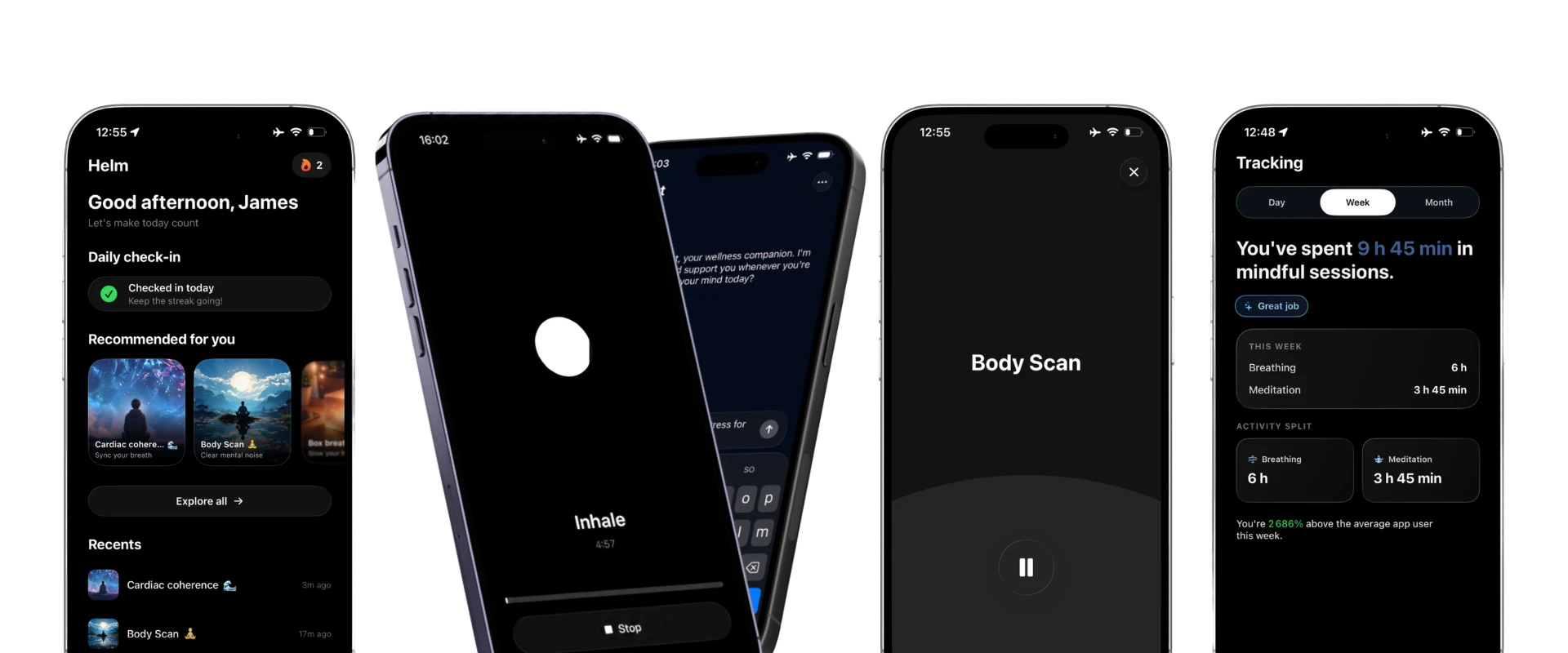
Use it on good nights to make it familiar, then lean on it when stress spikes or you wake in the middle of the night. The most important marker is not how perfectly you count, it is whether your body feels even 5 percent softer after a few cycles. If you want a guided version of this reset and other quick routines, try Helm, an iOS mental wellness app designed to manage stress and improve focus through guided breathing resets.
Most people do 3 to 6 rounds. Start with 3 to avoid lightheadedness, then build to 6 if it feels comfortable and you notice your body softening.
Yes, it can reduce nighttime arousal by emphasizing a longer exhale and giving attention a simple task. It works best when you keep the inhale small and the pace gentle.
You are likely overbreathing or pushing the hold. Make the inhale quieter, shorten the hold, and try a no-hold version like 4 in, 6 out for a few minutes.
Often, yes, because it emphasizes a longer exhale, which many people find more sedating. Box breathing can be great for daytime calm, but some find equal counts too alerting at bedtime.
Yes. Keep it subtle and avoid big breaths. If you feel pressure to fall back asleep, do 3 rounds, then let go of counting and return to natural breathing.
Join thousands using Helm to manage stress, improve focus, and build lasting healthy habits.